
Building the future of food manufacturing in Nelson
The owner of Mountain Munchies reflects on nearly a decade of growth
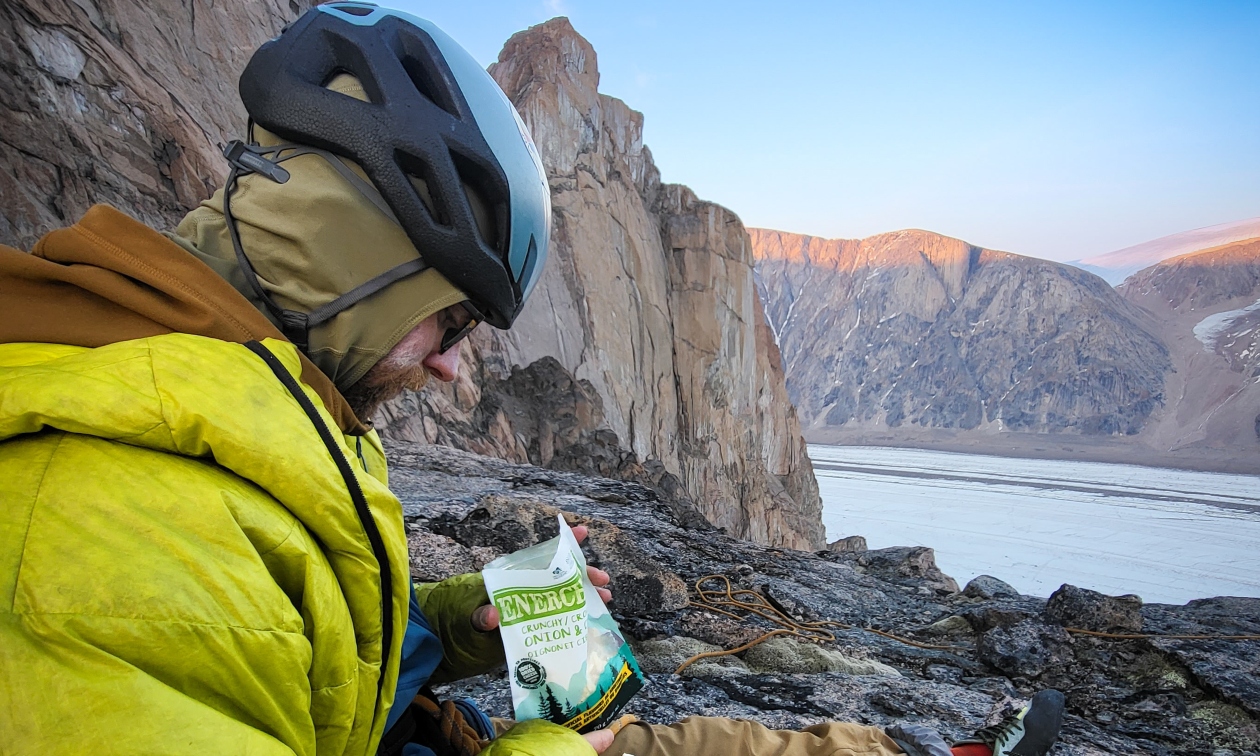
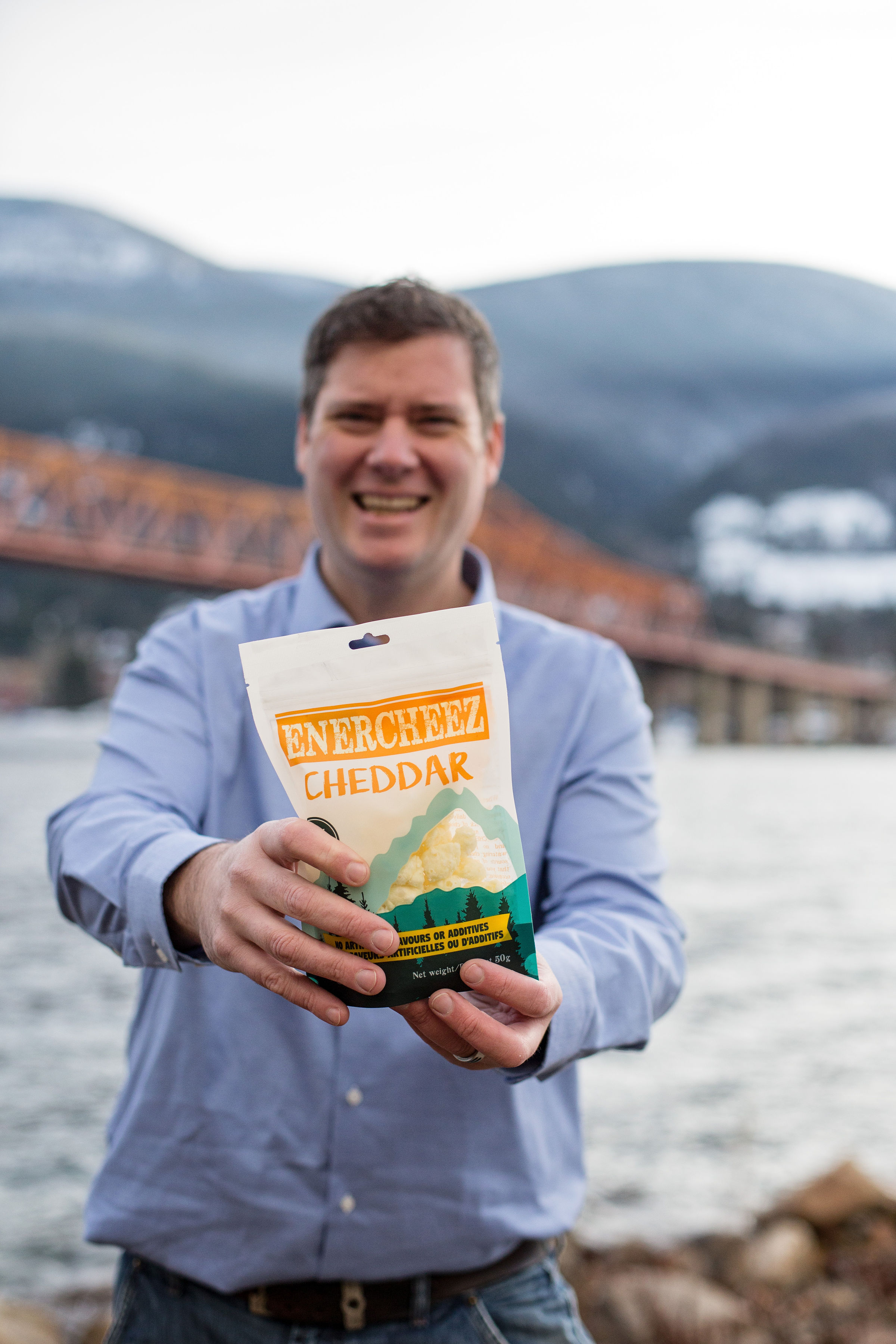
In 2017, Nelson entrepreneur Bruce Burgener was experimenting with prototype vacuum-dehydration technology his father had been developing, looking for ways to turn different foods into shelf-stable products. The experiments eventually led him to Mountain Munchies, the food manufacturing company behind Enercheez, a dehydrated snack made from Canadian cheese.
But the story of Mountain Munchies is about more than turning cheese into a portable snack. Burgener has spent nearly a decade figuring out how to build a food manufacturing company in a small Kootenay community, from getting new technology approved and finding a market for his products to navigating freight, infrastructure and the challenges of scaling. Along the way, local businesses, organizations and employees have played a role in the company's growth. Now, with a new manufacturing facility in Nelson and bigger possibilities for the technology behind Enercheez, Burgener is looking at what comes next while staying committed to building the company at home.
What was happening in your life and career that led you to start Mountain Munchies?
In 2017, I had the opportunity to take the prototype dehydrators that my father was working on with another gentleman and try using the advanced vacuum dehydration prototype on typical food waste products. I experimented with apples and spent grain from breweries, but the process seemed very labour intensive. That's when I decided to try cheese, starting with mozzarella.
At the time, there was only a handful of other companies in the world that could actually dehydrate cheese products using similar technology, but with different patents. It was an American-based company making American dried cheese. We found that once the cheese was dehydrated, ours was much puffier and actually tasted like cheese, unlike our competitor's product.
What was the original idea for Mountain Munchies, and how did that idea evolve into Enercheez?
The idea evolved quite a bit, from trying to dehydrate different food products to ultimately dehydrating cheese. Enercheez ultimately came from figuring out how we could take real Canadian cheese and turn it into a shelf stable product without baking it or turning it into something that barely resembled cheese anymore.
My father and I modified one of the prototype dehydration machines to safely dehydrate cheese. That became Enercheez: a shelf stable dehydrated cheese snack that's high in protein, has zero carbs and doesn't require refrigeration.
The technology has become a big part of Mountain Munchies. What started as a food product has really grown into a manufacturing process and platform that has potential well beyond just the products we're making today.
Why was Nelson the place you wanted to build your business?
Nelson is home. I live here, my family is here, and I wanted to prove that you don't have to move to Vancouver or another major centre to build a food manufacturing company with national and international potential.
There are definitely challenges that come with being here, but there are also things you get in the Kootenays that are hard to replicate somewhere else. There's a strong sense of community, people support local businesses, and there's a real entrepreneurial spirit here.
You've said Enercheez was born in the Kootenays and reflects the people who live, work and play here. What does that mean to you as a business owner?
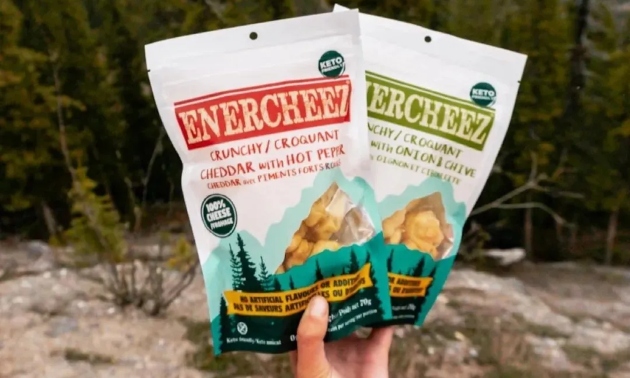
Enercheez fits the Kootenays really well. People here hike, camp, ski, bike, work outdoors and generally spend a lot of time outside. They want food that's easy to carry, doesn't need refrigeration and actually gives them something nutritionally. Actual food!
A 70-gram bag of Enercheez has 28 grams of protein and zero carbs. You can throw it in a backpack, truck or lunch bag and not worry about keeping it cold.
To me, that's a pretty Kootenay product. It's practical, a little different, and made for people who would rather be outside doing something.
What are the advantages of building a food manufacturing company in a smaller community like Nelson?
One of the biggest advantages is the community. You actually get to know the people you're dealing with, whether that's other businesses, employees, suppliers or customers.
There's also a lot of pride that comes with making something here and then seeing it sold outside the region. When you start seeing something made in Nelson showing up in stores across Canada, that's pretty cool.
We also have access to people who are resourceful. In a smaller community you learn pretty quickly how to solve problems yourself because the solution isn't always five minutes down the road. As I tried different products, I had meetings with the crew at Kootenay Co-op grocery store. They helped me with packaging ideas, weather a food product would be viable and at the end they were the first store that decided to sell my products.
And what are the challenges? Is there anything about operating in the Kootenays that makes scaling a business more difficult?
Absolutely. Freight is a big one. We're a long way from the major distribution centres, so almost everything coming in or going out costs more.
Finding specialized equipment, trades and technical expertise can also be harder. When something breaks or you need a very specific piece of equipment, you can't necessarily call someone locally and have them there that afternoon, especially with equipment no one knows how it works.
Infrastructure can be another challenge. As we have learned while building our new facility, something as basic as getting the electrical capacity needed for food manufacturing can become a major project and a huge unexpected cost. There are not many buildings in the area that have three phase power for typical industrial equipment. Also the majority of the buildings are well over 50 years old, making it a challenge for current food inspections.
Those things don't make it impossible to scale here, but they definitely make you creative.
How important has the local business and entrepreneurial community been to Mountain Munchies' growth?
Very important. We've had a lot of support over the years from people and organizations in the region.
When you're building a business, especially a manufacturing business, there are a lot of points where you could easily decide it's too difficult. Having people around you who understand what you're trying to accomplish makes a difference. Utilizing agencies like Export Navigator, Community Futures ect. Put you with other people that have gone through the process in the past and allowing us to not make the mistakes they made. That's a huge cost saving advantage.
We've also been fortunate to receive recognition along the way. Mountain Munchies was a Small Business BC finalist early on in 201.Being recognized at SIAL Canada was a big one. Our Poutine Enercheez was selected as a SIAL Innovation product in 2024. SIAL is North America's largest food innovation tradeshow. Having people from the food industry look at what you're doing and recognize that it's genuinely innovative means a lot. More recently we received the BC Food & Beverage RISE Award for innovation in 2025. Those things help confirm that what we're building in Nelson can compete on a much bigger stage.
What have you learned about finding and keeping good people in a smaller community?
Good people are everything, especially in a small community.
In a business our size, you're not hiring someone to disappear into one tiny role. Everybody has an impact. You need people who are willing to learn, adapt and sometimes jump in and do something completely different because that's what needs to happen that day.
As we've grown and moved toward the new facility, we've been able to add employees, and creating more local jobs is something I'm proud of. The goal isn't just to grow sales. It's to build something sustainable here that creates opportunities for people in the community.
What does the average customer probably not understand about what goes into making a shelf-stable food product?
Probably almost everything behind the bag!
People see a bag of Enercheez on a shelf, but behind that is years of work. There is food safety, testing, water activity, packaging, shelf-life work, equipment, inspections, traceability, sanitation procedures and federal regulations.
We're federally inspected, and we have extensive food-safety procedures and documentation that go along with manufacturing food.
Our product has a two-year shelf life and a water activity of around 0.30. Getting a real dairy product to that point while making something that still tastes good is not as simple as just drying some cheese. We have to dehydrate the cheese within 40 minutes. That's where the technology comes in. If you used a typical low temperature dehydrator it would take hours to dry. That would be unsafe and not safe for human consumption.
There's an enormous amount happening behind a product that the customer hopefully never has to think about.
Was there a particular retailer, customer or piece of feedback that made you realize Enercheez was catching on?
There have been a few moments. Having our products on shelves at Whole Foods, Save on Foods, Safeway, Thrifty's Foods and all the little markets and mom and pop shops all around Canada is just amazing. I can go into a store, winery, brewery really anywhere and I see Enercheez on the shelves. Sometimes not even knowing that store carried them!
We've also had opportunities with major retailers, including Costco, Walmart which makes you realize that something you started in Nelson has the potential to operate on a completely different scale.
But some of the best feedback still comes from regular customers. When somebody tries it, comes back and buys it again, or tells someone else about it, that's when you know you have something.
What have you learned about taking a Canadian food product into other countries?
I've learned that making a good product is only the beginning
Every market has different regulations, labelling requirements, logistics, distributors and expectations. Exporting food isn't as simple as putting cases on a truck and finding someone willing to buy them.
At the same time, being Canadian is an advantage. There's a strong reputation around Canadian food and food safety, and we're proud that Enercheez is made from Canadian cheese and manufactured here in British Columbia.
The challenge is building the infrastructure and relationships to take advantage of that opportunity.
I understand the business received provincial funding this year. What does that investment make possible that wasn't possible before?
The funding has helped us make a major step forward with our new food manufacturing facility in Nelson.
Our existing production setup limits how much we can produce. The new facility gives us the space and infrastructure to increase production significantly, add equipment and employees, and go after opportunities that simply wouldn't be practical at our current scale.
We've designed the facility around food manufacturing and future growth. We also have equipment planned that can process significantly more product than we're capable of producing today.
It's really about moving Mountain Munchies from where we are now into the next stage of the company.
What is the biggest challenge that comes with scaling a company like this?
Capital and timing.
Growth sounds great until you realize you have to pay for it before the growth happens. Equipment, buildings, packaging, inventory, employees, certifications and infrastructure all cost money before the additional revenue shows up.
We're experiencing that firsthand with the new facility. Construction costs have increased dramatically, equipment costs have gone up and there are always unexpected expenses. Trying to get an accurate quote to do budgeting is extremely difficult these days as things fluctuate every three months.
The challenge is growing fast enough to take advantage of the opportunities in front of you without growing so fast that you put the company in a difficult financial position.
If everything goes according to plan over the next three to five years, what does Mountain Munchies look like?
I'd like to see Enercheez widely available across Canada and established in the U.S. and other export markets.
I want the new Nelson facility operating at its potential, with more employees and much greater production capacity. We currently have the ability to produce around 35,000 units a month with two shifts, and the next generation of equipment changes that capacity significantly.
I also think the bigger opportunity is the technology itself. The process we've developed isn't limited to one flavour or even necessarily one type of product. There is a much larger opportunity around what this technology can do with dairy products.
Ultimately, I'd like Mountain Munchies to show that you can build an innovative food manufacturing company in a place like Nelson, employ people here and sell what we make all over the world.
When you look back at the Bruce who started Mountain Munchies in 2017, what would he be most surprised to learn about where the company is today?
Probably that I'm still doing it! Seriously, I think he'd be surprised by how far an idea could go and how many times we'd have to reinvent, adapt and figure things out along the way.
I personally went to every grocery store in BC, cold calling managers and trying to get my products on the shelves. It's a difficult achievement and I didn't think in 2017 I'd be where I am today.
I had to get the dehydration technology approved from the federal government, become a federally inspected manufacturer, receive national industry recognition, have conversations with some of the biggest retailers in North America, and build a dedicated food manufacturing facility here in Nelson.
He'd probably also be surprised by how difficult it all was.
But I think he'd be pretty happy that, almost ten years later, we're still building it here in the Kootenays.




Comments