
Nelson’s Chocofellar embraces a bean-to-bar model
Owner Aurélien Sudan discusses the world of craft chocolate, sustainability, and growth
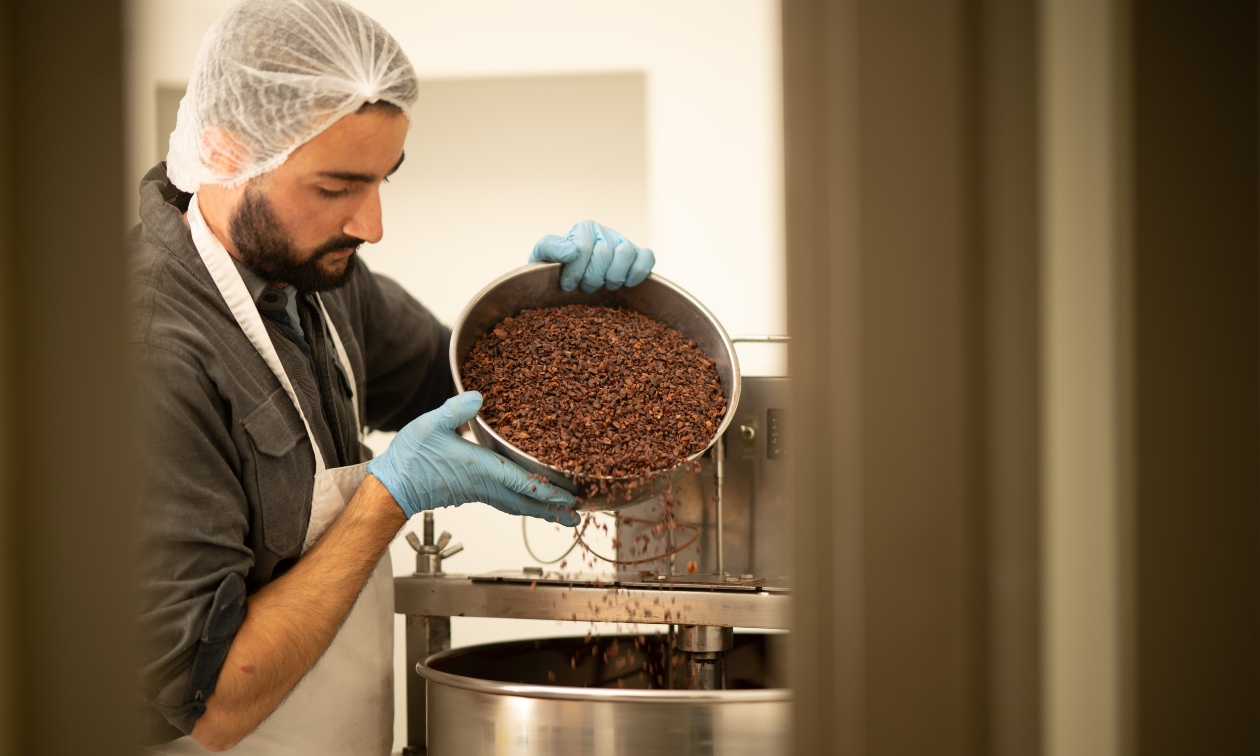
Aurélien Sudan, owner of Nelson’s Chocofellar, works with cacao during chocolate production at the company’s Nelson facility. — Photos courtesy of Adrian Wagner
Behind every handcrafted chocolate is a long chain of choices: where the cacao comes from, how it’s processed, and who gets supported along the way. For Aurélien Sudan, owner of Nelson’s Chocofellar, chocolate wasn’t always the plan. What began as a career in marketing and outdoor sports eventually led him back to a family legacy rooted in Swiss chocolate engineering.
Since taking over the business in 2021, Sudan has leaned into bean-to-bar craft, direct-trade cacao, and deep local collaboration. We spoke with him about passion, flavour, and the realities of running a small chocolate business in a volatile global market.
What first drew you to chocolate-making, and how did your Swiss background shape your approach?
I honestly had no idea I was going to work with chocolate up until I turned 30 years old. After university, I worked in mountain sports industries (heliskiing, rafting, paragliding) for three years in marketing/photography/jack-of-all-trades, before segueing into multiple start-ups in Vancouver. My great-grandfather Bernard Boschung was a chocolatier engineer from 1898 until around1920 for Cailler in Broc, Switzerland, and I was pursuing a career in marketing and start-up promotion when I met chocolatier John Down in 2017. John was the founder of Christopher Norman Chocolates, now located in Halfmoon Bay, B.C., on the sunshine coast. John and his partner Joe together had a very successful, pioneering career in chocolate crafting in the heart of New York City during the 1990s and early 2000's, and it is while helping him, tasting his sublime, near-perfect confections, and seeing him at work that I discovered a new obsession.
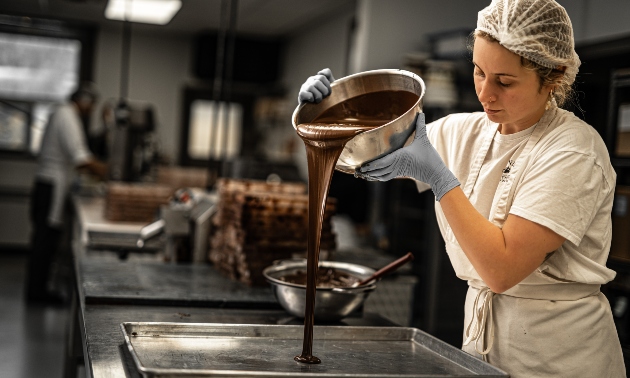
Maddie Goreski, co-owner and head chocolatier at Nelson's Chocofellar, brings extensive pastry and confectionery experience to the company.
What inspired you to take over Nelson’s Chocofellar in 2021?
From 2017 until 2021, I did a lot of chocolate experiments on my own. I bought some moulds, spatulas, a thermometer, got a small stone grinder, and started experimenting with making chocolate from scratch, as well as craft confections, pralines, learned the basics of tempering chocolate, ganache science and cooking caramels for various desserts. When I met the Chocofellar founders Sam and Hollie, they were not keen to have employees. They wanted to pass the torch to someone passionate, eager to learn their craft and recipes, and carry the local tradition further.
Can you tell us a bit about bean-to-bar chocolate compared with traditional confectionery?
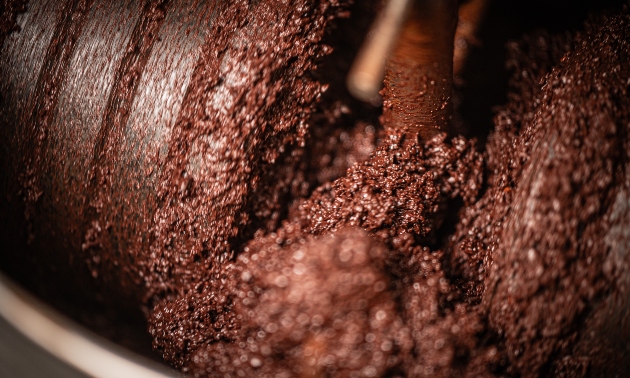
Our process to make bean-to-bar is both complex, artisanal and rudimentary. We use stone-grinders to produce the chocolate, after the beans have been sorted, roasted, and winnowed (removing the husk). It allows us to use some of the best cacao beans in the world from sustainable origins, and have some flexibility in our supply chain. Working with craft chocolate is different than commercial chocolate. It is a little less predictable, and requires more finesse. However, it also comes with a bigger depth of flavours than commercial chocolate.
I feel lucky that I first got training from John Down, Sam and Hollie for confectionery work, where shelf life, texture, consistency and the visual Midas touch is everything.
Starting my career in chocolate with the finishing steps and retracing it back to working with raw, fermented and sundried beans allowed us to know and experience first what good consistency, fluidity, and taste standards are and study the ratios of each sourced ingredient, before attempting to create our own couverture chocolate equivalent.
Some chocolate might taste delicious, but if it isn't fluid enough, it would be really hard to make confections with, which is why a lot of bean-to-bar chocolate makers stick to making bars, rather than cast complex shapes, make pralines, truffles and confections.
Why did you choose direct‑trade cacao from northern Colombia specifically?
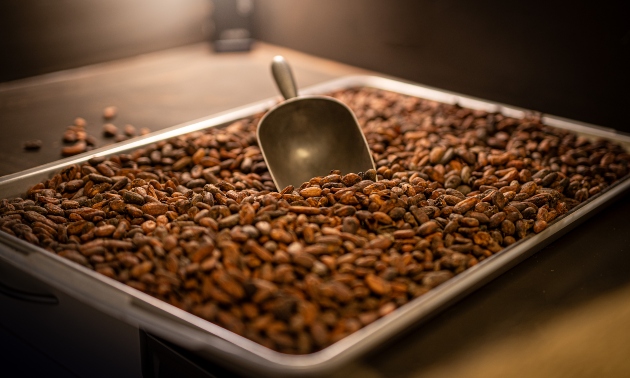
We wanted the bulk of our cacao to come from South America to reduce our carbon footprint, and to support the farmers in a more direct, impactful way (we do not set the prices, the municipal farms do) rather than have big corporations as cacao middlemen. Given the current international trading instability, having a reliable, continental source of cacao was very important to us. When we first tasted this Colombian cacao, we got seduced by its flattering aroma and complex flavours and reassured by seeing first-hand that it is grown sustainably in biodiverse farming cultures, surrounded by avocado trees, mandarin trees, bamboo, coffee plantations, etc. The Northern district of Santander is responsible for 25% of the national cacao grown in Colombia. Not only the climate, elevation and moisture are prime for growing, the farming know-how rewarded the region of San Vicente de Chucuri and Carmen de Chucuri to win the coveted prize of "Best cacao in the World" at the 2019 Salon du Chocolat, Paris.
Not only does it taste fabulous, it is very versatile in being able to pair with other flavours. Some other cacao tastes perhaps more exotic and refined, but are less interesting to use in confectionery work if the flavor is too bold and pronounced.
What are the biggest challenges you face in your industry, and how do you navigate them?
Both the international trade wars, paired with ongoing global cacao shortage over the last few years have exacerbated raw good prices and availability. Managing cash flow at times of ingredients cost fluctuations is a big challenge, especially when preparing big holidays like Christmas. We are doing everything we can to flatten the dies, by working directly with cacao farming regions who use biodiverse, sustainable farming practices, as well as ordering Canadian milk powders and local, B.C. ingredients when we can (raspberries, hazelnuts for instance). It is our responsibility as a small business undergoing fast growth to do all that we can to remain sustainable.
Do you collaborate with other local retailers and producers in the Kootenays?
Yes we do! We get our coffee beans from No6 Coffee, our cream and milk from Kootenay Meadows, we purchase many ingredients from local retailers such as Kootenay Coop or Ellison's Market, and we are planning a couple more collaborations for the winter with other local culinary talents in town. We also have developed amazing support from local retailers and independent grocers/food producers in the Kootenays over the years.
What role does online sales play in your business model, and how do you balance it with retail?
Online sales are a minor component of our business, but it helps expose our food craft and brands beyond the direct district.
We also have our website set up so people can order ahead of time and pick-up directly at our store, which adds to the local convenience.
What are your goals for Nelson's Chocofellar in the next 3–5 years?
After a few rocky years undergoing big internal revolutions, we are aiming to keep on our steady growth trajectory, while maintaining our values, customer satisfaction, sustainability , ethics and overall quality as top priorities. A business that has survived 35 years deserves to keep going.
How do you approach hiring and training, especially for artisanal roles?
At first, all I could afford was a bit of help from friends at seasonal times. Now, the team has grown. We are hiring based on skills, personality and flexible capacity to integrate our niche market. Everyone on our team contributes something different to the company. Training takes time in chocolate, as it takes at least one year even for someone with pre-existing kitchen experience to become well versed with all the aspects of chocolate production.
What has been the most rewarding aspect of running the company so far?
Managing to survive big highs and lows and overcoming adversity by daring to take big risks such as radical changes in the manufacturing process, and production/retail location—all in one year. When the costs of raw core ingredients fluctuates up to 400% in one year as cacao did in 2024-2025, it takes a David versus Goliath mentality to have a chance to survive as a small business.
Is there anything else you would like to share?
We have been blown away by the local support since opening "La Chocolaterie", our new microfactory and retail space on Vernon Street. On Halloween, our official opening day, we even had kids show up disguised as Willy Wonka and Oompa Loompas, a golden ticket in hand. We were lost for words. Thank you, people of Nelson, you have helped us survive and overcome some of the most challenging times of our business history!




Comments